Surveys people answerby talking, not typing
Tell Voivey what you want to know. It writes the questions and follows up on what each person says. You get the conversation and keep your week.
Try it before you sign up. No card, ever.
The hard part is asking the right question
- You guess in advance what is worth asking.
- You write it as neutrally as you can.
- You send it out.
The answers come back. The one you cared about is six words long.
Or they have answered a different question. Or they have told you something true about a thing you were not asking about.
The interesting thing sits there unasked. In the room, you would have followed it up.
You know roughly what people think. You still do not know why.
How has the last quarter been for you?
Fine thanks
Surveys can hold a conversation now
Ask the thing you actually wanted to ask. Send it to everyone you need to hear from.
Tomorrow morning you read the answers. Each one got its follow-up, and for the first time you know why.

Say what you want to know. Voivey works out the questions
1Say what you want to find out
Describe the thing you are trying to learn. Voivey asks a few things back, then turns that into the questions, in the order to ask them.

2Send the link
The people you send it to open it in a browser. No app, no account, nothing to install. Questions arrive one at a time, or grouped, so they can answer a few in one go.
3Read the write-up
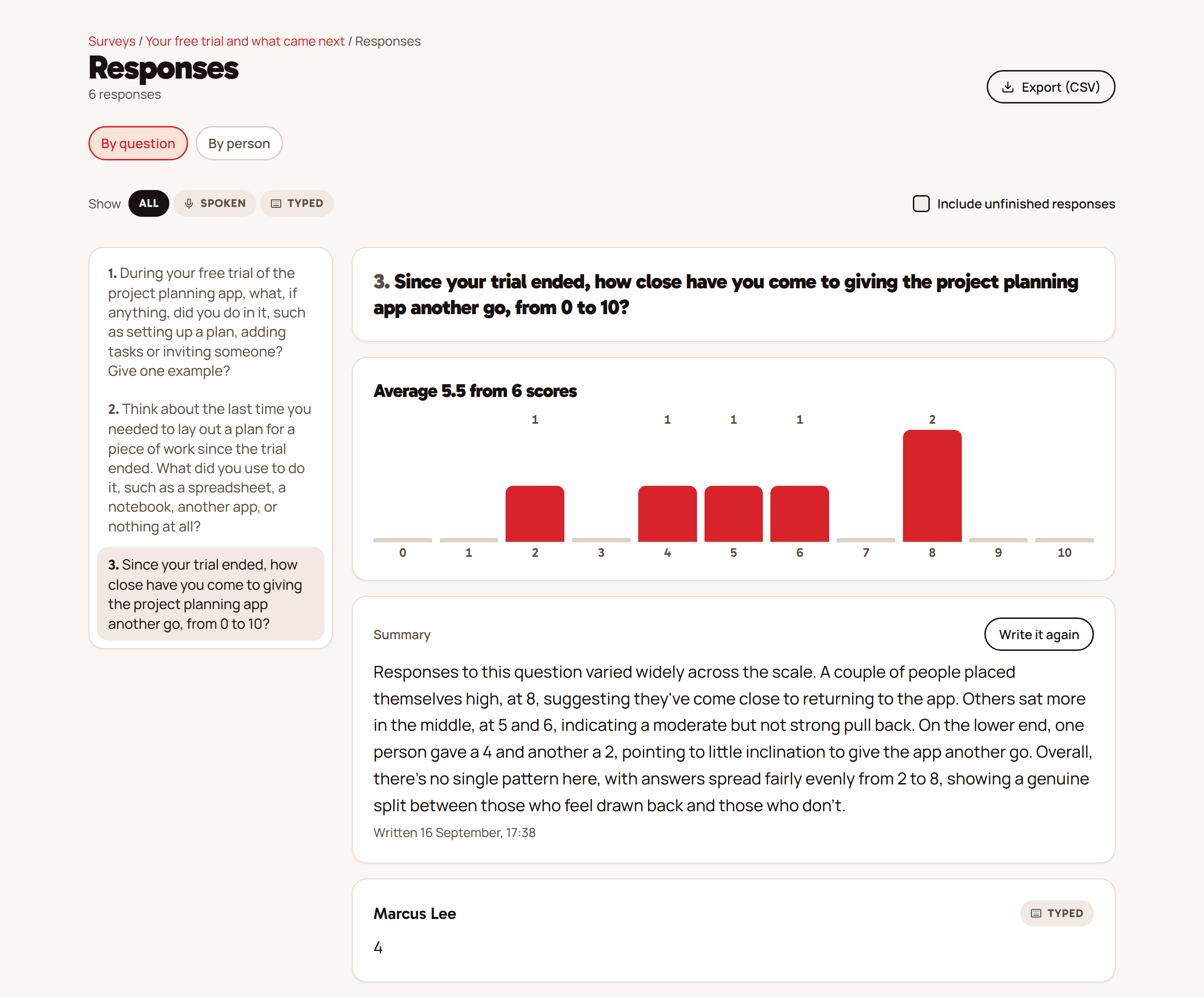
Every answer comes back as text. Summarised, with every answer in full underneath.
It asks the follow-up you would have asked
A form asks what you thought of when you wrote it. Voivey asks about what the person just said.
Somebody says their review was useful but rushed. A form moves on to question four. Voivey asks what made it feel rushed.
Now you know something you did not think to ask.
It does that with every person, one at a time, however many there are.
It knows when to stop. If someone twice says they would rather not answer, it stops asking.
You get the conversation you would have had with each of them. It does not cost you the week.
So how do you compare answers that all went different ways?
The second question comes from the first answer.
You still get numbers you can compare
Everyone gets the same core questions, in the same order.
Ratings and multiple choice come up as buttons, so nobody has to say a number out loud. The totals add up like any survey.
Only the follow-ups differ, because they come from what each person said. They sit under the numbers. They do not replace them.
Same questions to everyone. Different follow-ups to each.
You get the words. Nobody keeps the voice
The browser sends the audio straight to our speech provider and gets the words back. The audio never passes through our servers, and no recording is kept anywhere.
The words on screen are the words as heard. They are never rewritten. You can delete anyone's answers.
Answers arrive as text. The audio is gone by then.
Three of the questions people send
A people lead
“How did your last review go?”
Sent to everyone who had one. Each of them gets asked why it felt that way.
A founder
“What nearly stopped you signing up?”
Sent to last month’s new customers. You hear what the pricing page did not answer.
An events team
“What would you change about today?”
Sent as people leave, while they still remember the session that ran over.
People say more out loud than they will ever type
1 in 5
open questions gets skipped
For multiple choice it is closer to 1 in 50. It gets worse the more thinking a question takes, and worse again on a phone.
Pew Research Center
Twice
as much said out loud
Same question, spoken instead of typed. The answers come back more than twice as long and cover more separate topics.
Smartphone survey experiment
3× faster
for the person answering
153 words a minute speaking against 52 typing on a phone. Thinking time costs nothing, because silence is not sent.
Stanford, Washington and Baidu
When to use it, and when not to
Use it when
- You need an answer from more than about five people
- You care why, not only what
- The question does not justify putting a meeting in
Do not use it when
- You need a registration or booking form
- You need thousands of answers as cheaply as possible
- The answer you need is a number, not a reason
6 things people ask before they try it
What if someone cannot speak right now?
They type instead. Every question takes a typed answer, and the follow-up works the same way.
Do they need an account or an app?
No. They open a link and answer.
Do I have to write the questions?
No. Say what you are trying to find out and Voivey writes them.
How is this different from a form builder that takes voice input?
A form builder lets someone speak an answer into a question you wrote. Voivey writes the questions and follows up on what they actually said. A fixed form cannot ask about something it did not anticipate.
Can I still ask ratings and multiple choice?
Yes. They come up as buttons, so nobody says a number out loud. The totals add up like any survey.
What does it cost?
Free until 30 September. After that you buy credits. One credit is one question to one person.
Ask the question you were going to put in a meeting
Say what you want to find out. Send the link. Read the answers tomorrow.
Create your first voice surveyFree until 30 September. Try it before you sign up. No card, ever.